Louisiana window tinting laws changed on August 1, 2025, and many online guides still show the old numbers. Front side windows now need at least 25% visible light transmission (VLT), down from the old 40% minimum.
Southside Tint & Detail installs film for drivers in Houma and across Terrebonne Parish. This guide explains every window, shade, and exemption using limits checked in October 2026.
What Are the Louisiana Window Tinting Laws in 2026?
Louisiana window tinting laws are set by R.S. 32:361.1, and the 2026 limits match the 2025 amendment. Act 143 of 2025 lowered the front side window minimum from 40% to 25% on August 1, 2025. A review of the legislature’s current statute text found no later change.
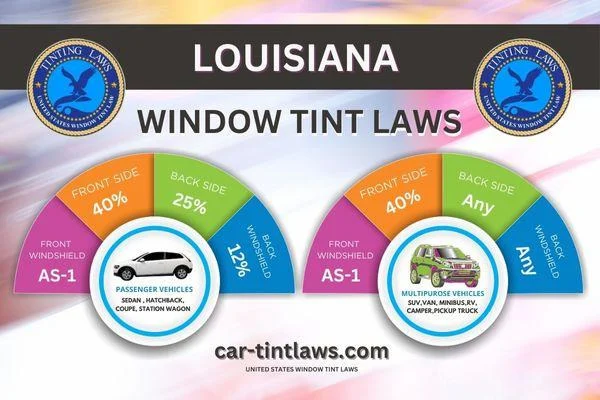
The table below shows the limits by window and vehicle type. VLT means visible light transmission, the share of light that passes through the glass and film together.
| Window | Cars (sedans, coupes) | SUVs, vans, trucks, buses |
|---|---|---|
| Windshield | Non-red, non-amber strip in the top 5 inches only | Same |
| Front side windows | 25% VLT or higher | 25% VLT or higher |
| Rear side windows | 25% VLT or higher | No VLT minimum |
| Rear windshield (back glass) | 12% VLT or higher | No VLT minimum |
| Reflectance, all windows | 20% or less | 20% or less |
The limits are statewide, so Houma, Baton Rouge, and New Orleans follow the same numbers. The statute adds the phrase “all tolerances included,” which leaves no margin for film that tests slightly low. It covers vehicles built on or after January 1, 1994, with a certificate exception for tint installed before that date.
How Dark Can Front Side Window Tint Be in Louisiana?
Front side windows must allow at least 25% VLT. That makes 25% the darkest legal reading on front doors for every vehicle type, including SUVs and trucks.
Before August 1, 2025, the minimum was 40%. Rep. Daryl Deshotel sponsored the change, and several online guides still list the old figure. A Louisiana front window tint law check should always use the post-2025 statute.
In Houma, Southside Tint & Detail checks the legal shade on every window before installation. Front doors matter most, since the 25% rule applies to every vehicle type. The shop also explains the difference between HITEK carbon and ceramic film before cutting any film.
Is Windshield Tint Legal in Louisiana?
Only a narrow strip is legal. The Louisiana windshield tint law allows a transparent, non-red, non-amber material on the top of the windshield. It can extend no more than five inches down.
The statute does not separately allow clear film on the rest of the windshield. Material below that strip falls under the general ban in R.S. 32:361.1(B), unless a state exemption applies.
A sun strip legally handles low-sun glare. Houma drivers can book one through car window tinting packages that place the band at or above the legal line.
What Are the Rules for Rear Side Windows and the Rear Windshield?
On cars, rear side windows behind the driver need at least 25% VLT. The rearmost window, also called the rear windshield or back glass, needs at least 12% VLT. These are the Louisiana rear window tint laws for sedans and coupes.
Both numbers describe the combined reading of film and glass. A 5% film on a sedan’s back glass fails the 12% minimum. The same film can be legal on an SUV.
Southside Tint & Detail offers a Sides and Rear Glass package for drivers in Houma, Thibodaux, and Morgan City. The shop keeps shades within these limits on cars and offers darker options only on qualifying vehicles.
Do SUVs, Vans, and Trucks Follow Different Louisiana Tint Rules?
Yes, for windows behind the driver. R.S. 32:361.1(D)(4) exempts those windows from the light transmittance rule. The exemption covers trucks, buses, trailers, motor homes, and multipurpose passenger vehicles.
Most SUVs are classed as multipurpose passenger vehicles, and vans usually fall under that class or as trucks. Crossovers and some vans can land on either side of the line. Classification should be confirmed before dark film is ordered.
Front side windows still need 25% on every vehicle type. The 20% reflectance cap and the windshield strip limit also apply to SUVs, vans, and trucks.
Planning front-door tint in Houma after the August 2025 law change? Call (985) 790-4316 to discuss your vehicle and compare legal shades from 25% and up. Get a priced quote for front doors only or a full vehicle, with shades checked against state limits first.
Is 70%, 50%, 35%, 20%, or 5% Tint Legal in Louisiana?
Film at 70%, 50%, and usually 35% meets the Louisiana tint percentage rules on every window except the windshield. Film at 20% is too dark for front side windows. Film at 5% is legal only behind the driver on SUVs, vans, and trucks.
| Film shade | Front side windows | Car rear side windows | Car rear glass | SUV, van, truck windows behind driver |
|---|---|---|---|---|
| 70% | Legal | Legal | Legal | Legal |
| 50% | Legal | Legal | Legal | Legal |
| 35% | Legal, if the finished reading is 25% or higher | Legal | Legal | Legal |
| 20% | Not legal | Not legal | Legal | Legal |
| 5% | Not legal | Not legal | Not legal | Legal |
The percentage on a film box describes the film alone. Factory glass blocks some light too, so a film rated near the limit can test under it once installed. A margin above 25% is the safer pick for front doors.
Every shade in the table must also stay at 20% luminous reflectance or lower. Legal window tint in Louisiana therefore needs the right percentage and a non-mirrored finish on each window.
How Can Drivers Check Existing Tint Against Louisiana Limits?
A tint meter reads the share of visible light passing through glass and film together. That matches the statute’s measure, and each window needs its own reading.
Used-car buyers and drivers moving to Louisiana should check before registering. Other states set different limits, and film that was legal elsewhere can fall under 25% on a front door here.
A compliant job carries a small label naming the installer and city. It sits in the lower-right corner of the driver’s side window. A missing label does not prove the film is illegal, but a meter reading settles the question.
What Does VLT Mean, and Are Reflective or Colored Tints Legal?
VLT is the percentage of visible light that passes through the window. A lower number means a darker window. Louisiana defines light transmission to include the glass, so one reading covers film and glass together.
Luminous reflectance is how much light bounces off the surface. The statute caps it at 20% for all sun screening devices, which rules out mirror-style films. Non-metallic carbon and ceramic films are built to look neutral, not mirrored.
The statute names red and amber as barred colors for the windshield strip. The state inspection rule adds that front-glass tint must not alter the color of light passing through. Neutral charcoal and smoke shades avoid that question.
How Is Factory Privacy Glass Different From Aftermarket Window Tint?
Factory privacy glass is dyed during glass manufacturing. It usually sits on the rear doors, rear quarters, and back glass of SUVs and trucks. Aftermarket tint is a film applied to the glass afterward.
Louisiana’s statute regulates sun screening devices, meaning films used with safety glazing. Film added over privacy glass is measured together with the glass. The final reading drops below the film’s rating.
Legal limits matter most for heat control. HITEK quotes its Carbon IR and Ceramic IR infrared ratings at 5% VLT. Lighter legal shades reject less heat than those headline numbers.
Do Louisiana Tint Laws Say Anything About Side Mirrors?
The tint statute does not mention side mirrors. Mirror rules sit in a separate law, R.S. 32:354.
That law requires a left-side mirror that shows at least 200 feet of road behind the vehicle. It also requires a mirror inside the vehicle or on the right exterior. When the inside mirror’s view is blocked, a right outside mirror is required.
Heavy rear tint, privacy glass, and cargo can all limit the inside mirror’s view. A working right-side mirror matters most on those vehicles.
How Do Louisiana Medical and Security Tint Exemptions Work?
Louisiana allows darker tint with a medical exemption under R.S. 32:361.2. A licensed optometrist or physician completes a Louisiana State Police affidavit for a sun-related condition. Listed conditions include albinism, lupus, porphyria, and photophobia, which requires an explanation of why sunglasses are not enough.
Applicants sign a notarized medical records release and authorize a criminal history check. People convicted of violent crimes or drug offenses are not eligible. Applications go by mail because walk-ins are not accepted, and approved vehicles get a decal and a certificate.
Exemptions are reviewed every three years, except light-sensitive porphyria cases. Tint still cannot go below the top six inches of the windshield unless porphyria is diagnosed. A separate security exemption under R.S. 32:361.3 uses a State Police affidavit and has the same six-inch windshield limit.
What Are the Penalties, Stickers, and Inspection Rules for Window Tint?
Drivers face fines of up to $150, $250, and $350 for a first, second, and third or later offense. Sellers, installers, and distributors face $1,000, then $2,000, then a business ban after a third conviction. The full text is on the Louisiana Legislature’s R.S. 32:361.1 page.
Each installer must place a label no larger than 1.5 square inches between film and glass. It shows the installer’s name and city, and it goes on the lower right corner of the driver’s side window. Manufacturers must certify film compliance to the Office of Motor Vehicles with independent laboratory data.
Louisiana’s motor vehicle inspection rule, LAC 55:III.813, has its own window tint section. Published copies of that rule still list 40% for front side windows, which predates Act 143. Owners with front film between 25% and 40% should ask the inspection station how it applies the current statute.
What Are the Most Common Louisiana Window Tint Mistakes?
Five mistakes are easy to avoid with the 2026 rules in hand.
- Using old numbers. Pages that still list 40% for front windows predate the August 1, 2025 change.
- Trusting the film box. A film rated 35% can read lower after installation, so the finished reading is what counts.
- Putting 5% film on a sedan. It fails the 25% rear-side minimum and the 12% back-glass minimum.
- Tinting past the strip. Windshield film below the top five inches is not covered by the standard allowance.
- Skipping exemption paperwork. The certificate must stay in the vehicle, and exemptions do not transfer to a new owner.
What Should Houma and Terrebonne Parish Drivers Know About Legal Tint?
Heat, glare, and UV exposure build quickly on long South Louisiana summer days. Those are common reasons drivers in Houma, Gray, Bayou Blue, and Chauvin choose tint. The same rules apply in Thibodaux, Morgan City, and Grand Isle.
Shade choice balances comfort and compliance. Front doors need at least 25%, and a car’s back glass needs at least 12%. Pairing a legal shade with carbon or ceramic film keeps heat control without risking a fine.
Owners can speed up a quote by gathering four details first:
- The vehicle make, model, and body type
- Which windows need tint
- The shade and film type preferred
- Any medical or security exemption certificate
What Is the Bottom Line on Legal Window Tint in Louisiana?
Legal tint in Louisiana starts with 25% VLT on front side windows and 25% behind the driver on cars. A car’s rear glass needs 12% VLT, the windshield strip must stay within five inches, and reflectance must be 20% or less. SUVs, vans, and trucks have no VLT minimum behind the driver, and darker tint needs a State Police exemption.
Drivers who want film that follows these limits can book with Southside Tint & Detail in Houma. A fresh tint job also pairs well with auto detailing in Houma for a clean interior under new film.
Southside Tint & Detail in Houma can price a Louisiana-legal tint job for any car, truck, or SUV. Call (985) 790-4316 with your vehicle and the windows you want tinted. The team will recommend a shade that meets state limits and quote it before any work starts.
Frequently Asked Questions
Is 20% tint legal on front windows in Louisiana?
No. Louisiana requires at least 25% VLT on front side windows, so 20% film is too dark for the driver and front passenger doors on any vehicle. It is legal on a car's rear glass, which needs 12%, and behind the driver on SUVs and trucks, but not on a car's rear side windows, which need 25%.
Is 5% limo tint legal anywhere on a car in Louisiana?
Not on a car. Limo tint at 5% fails the 25% side window minimum and the 12% rear glass minimum. It is allowed only behind the driver on trucks, buses, trailers, motor homes, and multipurpose passenger vehicles such as most SUVs, and the film must stay at or under 20% reflectance.
Are 35%, 50%, and 70% window tint legal in Louisiana?
Yes. Each is above the 25% front side minimum and the 12% rear minimum, so all three are legal on every window except the windshield. Film ratings describe the film alone, and factory glass lowers the final reading, so a 35% film should be metered after install to confirm 25% or higher.
How much is the fine for illegal window tint in Louisiana?
Drivers can be fined up to $150 for a first offense, $250 for a second, and $350 for a third or later under R.S. 32:361.1. Installers and sellers face $1,000 for a first offense and $2,000 for a second, plus loss of the right to do that business after a third conviction. Fines are set by state law.
Can I get a medical exemption for darker window tint in Louisiana?
Yes. A physician or optometrist completes the Louisiana State Police affidavit for a qualifying sun-related condition such as albinism, lupus, porphyria, or photophobia. Applicants mail it with a notarized release. Approved vehicles get a decal, and exemptions are reviewed every three years.
Does Louisiana require a sticker or label on tinted windows?
Yes. Installers must place a label no larger than 1.5 square inches between the film and glass, showing the installer's name and city. It goes on the lower right corner of the driver's side window. Manufacturers also certify film to the Office of Motor Vehicles with independent lab data.